

Trieglaff’s Blue Line Farm awarded outstanding conservationists
News | Published on September 9, 2025 at 5:29pm EDT | Author: Kendall Koenen
0154-year-old farm flourishing with use of modernized systems
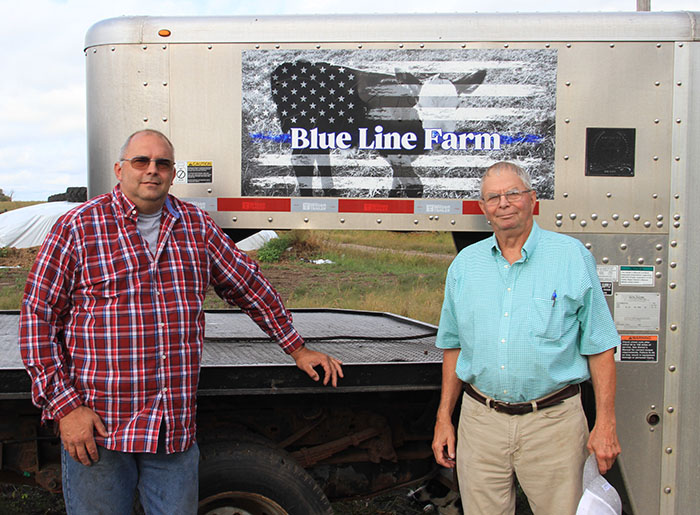
Tyler and Tom Trieglaff, along with partners Char Putnam and Margaret Trieglaff (not pictured), were recently recognized for their conservation efforts at Blue Line Farm with the 2025 Outstanding Conservationist award from the Becker Soil and Water Conservation District (SWCD).
By Robert Williams
Editor
Frazee’s Trieglaff family were recently honored with the 2025 Outstanding Conservationist award from the Becker Soil and Water Conservation District (SWCD) for their efforts to upgrade operations at their Blue Line Farm in rural Frazee.
The farm is located on the boundary of the west side of Wannigan Regional Park and has seen big changes in efficiency since adopting technical assistance and funding through the Environmental Quality Incentives Program (EQIP).
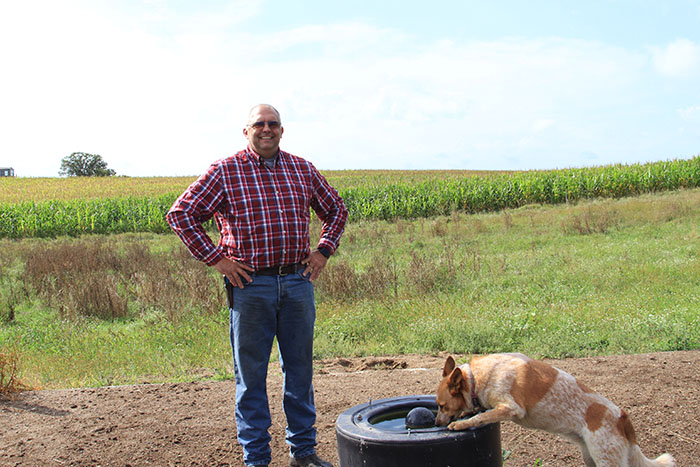
Tyler Trieglaff shows off an energy-free waterer that is used to hydrate cattle year-round, along with the collection of farm dogs at Blue Line Farm. The first waterer on the farm was connected to the well 600-feet away, bored underground below the frost line. The waterer is surrounded by a 20×20-foot concrete pad and insulation under the bowl.
“The practices that they’re doing, we provide financial assistance for producers to implement conservation practices to improve the land and productivity on the farm,” said Becker SWCD Administrator Bryan Malone. “Our award, we select each year somebody in the Becker County district that has implemented conservation practices and recognize their efforts for doing a good job of stewardship and working with our office.”
Each district submits their nomination to the state office for statewide recognition later in the year. One winner is selected from each of eight regions and from those eight a winner is selected in December at the SWCD convention in the Twin Cities.
According to Malone, Blue Line Farm is a prime example of the benefits that can be reaped by utilizing the conservation program correctly.
“They’re implementing that practice nicely and we’ve had adequate rain this year—that helps a lot,” he said. “They do a really nice job and are doing their best to get the most of their land as they can without degrading it and actually improving it.”
The land is special to the Trieglaff family as it has been Trieglaff land for more than a century-and-a-half.
Family history
on the farm
August Trieglaff settled the land that has now become Blue Line Farm in 1871, followed by Carl, Edward, Tom, Tyler and Tim and a sixth generation in Tyler’s son Carson. Early in the farm’s history, work consisted of general farming, butchering and lumber work with the saw mills.
“Then my dad milked cows for 30 years and I milked cows for 44 years,” said Tom.
“My grandpa Ed actually was in town and had the ice cream parlor,” said Tyler. “Must have been the early 40’s when they moved out here.”
Tyler and his brother Tim began the transition from a dairy farm 30 years ago when they were in FFA at Frazee-Vergas High School.
“We bought some heifers and bred them,” Tyler said. “We always had 10 or 15 cows and we’d rent a bull and started slowly expanding our herd. The most replacement heifers we kept at one time was 20. Usually we kept eight or 10 just to replenish the herd each year.”
Dairy farming came to an end in 2014. Tom had a heart surgery scheduled and the boys were doing chores in the barn on a cold February night.
“I was cleaning the barn and something with the piston pump broke, so I broke the barn cleaner on Friday. The cows went down the road on Monday and he had surgery on Tuesday,” Tyler said.
Tom was laid up for six weeks. Tyler began tearing apart the stanchions and drinking cups in the barn and that was the end of milking and the dairy farm. The 100-year-old barn is an antique A-frame constructed with hand-hewn 12×12 logs held together by wood pegs. The classic interior was reconstructed to serve beef production transitioning from milking pens to a holding pen.
“We weren’t going to milk anymore and by then we had 30-40 beef cows,” Tyler said. “We’ve just expanded from there.”
The farm now has between 70-80 cows and the Trieglaff’s have an annual goal of matching that number of calves each season. Forum subscribers get a front row seat to happenings on the farm from calving season to old equipment repairs from Tyler’s weekly column.
The hydraulic problem in the barn and the state of the market at the time were signs to switch to raising strictly beef cattle.
“We were milking 20 cows maybe and barely could keep the barn warm in the wintertime; it just was probably a sign that it was time,” Tyler said.
The fact that milking was far more taxing between the work and time compared to raising beef cattle also made the decision easy.
“The farming has basically stayed the same with the hay and the corn, but it’s the chores,” said Tyler. “Right now, it’s 10 in the morning and we haven’t done anything. Milking cows we would have had three hours of chores already.”
According to Tom, there are no cash crops on the farm as what the Trieglaffs grow is used strictly for feeding their cattle. Currently, hay prices are so low it is almost cheaper to buy it than make it.
“We bought some hay from a neighbor at a great price and now we have a two-year supply,” Tyler said.
The Trieglaffs also farm with aging equipment due to the fact they are able to repair them when needed, as opposed to modern equipment.
“There’s no technology we have to deal with, it’s just a matter of if I can fix it or not,” Tyler said. “We’re still farming in the 80’s and 90’s with 40-50-year-old equipment and it’s working for us.”
Award-winning changes
Looking to improve their pastures and operation in 2013, the Trieglaffs contacted Jeff Duchene, a grazing specialist with the Minnesota Natural Resources Conservation Service (NRCS) to consider pasture rotation while Tyler’s main interest was in cover crops.
“I thought the guy was nuts,” Tyler said.
Duchene utilized a map of the farm to show different watering systems and more fencing to break up pastures into paddocks.
“That just seemed impossible,” said Tyler.
Tom and Tyler went on multiple farm tours prior to jumping head first into the program to help answer questions like what kind of fencing would work better for their pastures and to get a look at the watering technology.
Fencing upgrades include controls for turning on and off their electric fences with a phone app.
“It saves a lot; I could be in Tennessee and turn the fence off,” Tyler said.
By 2020, NRCS Soil Conservationist Travis Doeden and District Conservationist Ed Musielewicz visited the farm proposing the Trieglaffs utilize the Environmental Quality Incentives Program (EQIP), that provides financial and technical assistance to agricultural producers and non-industrial forest managers.
After eight months, the farm was approved for the cost-sharing program to make big changes to the farm and its operation.
“Their share was around $70,000,” Tyler said.
The Trieglaffs put roughly $100,000 up front getting the majority of that returned on the backend, while providing all the labor for new fencing, water lines, a well, water tanks and energy-free waterers, along with specific pasture rotation plans. The fresh water also makes a big difference in the growth of both calves and full-grown cattle.
“All that working together, along with being Minnesota Ag Water Quality certified, were just little stepping stones and I heard a month ago when we were on this farm tour that we were selected by Becker Soil and Water,” Tyler said. “It’s a lot of work on their end. They get the farmers to do the right things and then it’s looking good for them.”
Earning the award takes a ton of work, despite Trieglaff’s humility, and despite his early doubts pasture rotation became the biggest and most important change from being in the program.
“We’ve got 15 or 17 paddocks here to just rotate them through and we don’t have to feed hay because of our rotation,” said Tyler. “We can’t graze it too low. That hurts the bugs and microorganisms and it all works together.”
Some fields are straight grass and others are pasture mixes with several types of grass with alfalfa and clover mixed in. The cows quickly learn that the opening of a gate leads to a fresh graze and are easy to move between the paddocks.
“It’s making life easier and efficient compared to the olden days,” said Tyler.
The cattle also help fertilize the pastures as they traverse from one paddock to the next and the program changes have also allowed the cows to be out in the winter the past four years.
“That way they’re putting that manure on the field every day all winter long and we don’t have to haul any manure in the spring which would take more fuel and more time,” Tyler said.
There are 25 different piles of food available to the 80 cows per day in the winter to help rotate the manure naturally.
Watering the cattle is the main concern, especially in the winter, and that was made possible through the program by placing watering stations throughout the pastures.
To do that, 9,000-feet of water lines were installed, some above ground along the fenceline and some below ground. The well is near the barn and allows watering to occur up to 3,000-feet away. Hydrants are placed along the lines to fill up the tanks and close off the exposed lines in the winter. Energy-free waterers utilize ground heat to keep water available in the winter. On cold days, some ice chipping is necessary to keep the liquid water exposed for the cows.
The program also provided six windbreaks as part of the out-wintering program.
“Everything works in conjunction,” said Tyler. “All of that has come back to this reward.”
Blue Line Farm has a social media presence. Follow on Facebook.