
Minnesota Senate Capital Investment Committee visits District 9
News | Published on December 9, 2025 at 2:14pm EST | Author: frazeevergas
0Legislators, community leaders tour Lunds, transitional youth housing facility in Perham
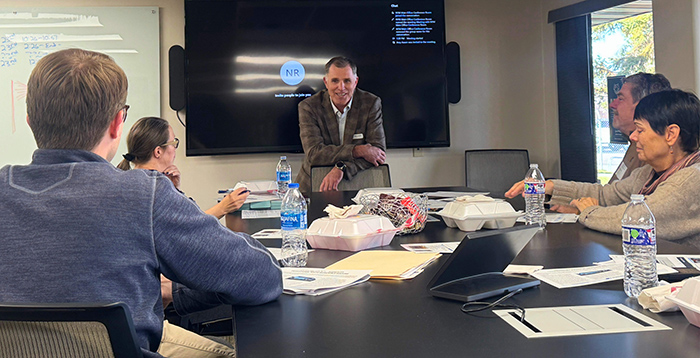
Nick Leonard, Otter Tail County deputy county administrator, highlights the proposal for a new youth transitional housing facility in Perham.
On Thursday, Nov. 13, Sen. Jordan Rasmusson (R-Fergus Falls), a member of the Minnesota Senate Capital Investment Committee, hosted the committee in Senate District 9 to hear directly from communities about priorities. Members learned about water projects, public water access, and youth and community development initiatives. The visit also included a tour of Lund and Crestliner manufacturing facilities in New York Mills.
“I enjoyed welcoming the Senate Capital Investment Committee to Senate District 9,” said Rasmusson. “From water system improvements to youth housing programs, it was valuable to hear directly from community members about their priorities. These conversations help ensure state resources are focused on the region’s most pressing needs.”
Otter Tail County
transitional youth housing
The meeting concluded with a presentation by Nick Leonard, Otter Tail County deputy county administrator, on a proposed transitional residential facility in Perham. The county is seeking $1.05 million in state bonding to build a 12-unit facility.
It would provide a safe, supportive place for youth ages 15 to 21 facing substance use, mental health, and other challenges. County staff and community partners would help residents access jobs, stable housing, education and life skills. This support would provide a foundation for long-term success and help meet local workforce needs.
“This facility will give our youth a safe place to grow, learn, and build the skills they need to succeed,” said Leonard. “Investing in these young people is investing in the future of our community.”
Lund and Crestliner
manufacturing tour
The visit began with a behind-the-scenes tour of the Lund and Crestliner manufacturing facilities. Legislators observed employees cutting, welding and assembling aluminum components. They saw the production process from raw materials to finished boats. The tour highlighted the company’s role as a major regional employer and economic driver.
New York Mills
water treatment
facility project
Following the tour, committee members met with local officials to review capital investment requests for the 2026 legislative session. In New York Mills, Mayor Latham Hetland highlighted plans for the city’s water treatment facility and well improvements. Constructed in the late 1960s, the plant is nearing 60 years of service and removes high levels of arsenic, iron, and manganese.
“Our current water treatment facility and supply wells have been handled extremely well over their decades of service,” said New York Mills Mayor Latham Hetland. “However, it is time to look toward the future. As a growing rural community, investing in our water supply is crucial for sustainability, and we appreciate the opportunity of partnership on this significant project.”
The city plans to build a new water treatment facility and supply wells on the south side of town. The project is estimated at $10.15 million, and the city is working with the Minnesota Public Facilities Authority (PFA) to secure low-interest loans and potential grants.
Battle Lake drinking
water project
The committee also heard from the City of Battle Lake about a proposed new municipal water system. In 2023, the Minnesota Department of Health notified the city that one of its wells tested above advisory levels for per- and polyfluoroalkyl substances (PFAS). A recently completed well, funded through a PFA grant, now serves as the community’s only safe water source.
“Battle Lake is among a small number of rural Minnesota communities to detect PFAS contamination,” said Val Martin, city clerk, treasurer and EDA director. “Our city has a proven track record of responsible infrastructure investment, with several recent water projects funded through state programs. This was an unexpected issue that we had not planned on. We’ve done our best to do everything right, and additional funding will help ease costs for residents and small businesses while ensuring safe, reliable drinking water.”
To address the issue, the city plans to build a new municipal water system with a backup supply and is considering coordinating with the nearby City of Clitherall on a shared well. The municipal system alone is estimated to cost $8.45 million.
Public water access
preservation
Representatives from the Minnesota Department of Natural Resources (DNR) and MN-FISH, a nonprofit that supports sportfishing, emphasized the central role public water access plays in lake-region communities. These access points support tourism, recreation, and local businesses in Senate District 9 and allow residents to safely enjoy Minnesota’s lakes.
The groups asked the Capital Investment Committee to fund DNR efforts to repair failing public water access points and acquire land for future public use.
“Water access is key to serving all Minnesotans,” said Mark Holsten, MN-FISH executive director. “It allows families, anglers, and visitors to enjoy our lakes safely and responsibly. It also supports local businesses and ensures that these natural resources can be enjoyed by future generations.”
Minnesota lawmakers will convene Feb. 17, 2026, to begin the legislative session and consider a state bonding bill to fund infrastructure and community projects.