

Jepson named new Becker Board chair
News | Published on January 13, 2026 at 1:25pm EST | Author: frazeevergas
0MR-C Transmission project discussed

By Robert Williams
Editor
District 1 Commissioner Erica Jepson was the lone nominee and unanimous appointee to become the new chairman of the Becker County Board of Commissioners on Tuesday, Jan. 6.
In a second vote, District 2 Commissioner Phil Hansen was voted in as Vice Chair.
Jepson replaced David Meyer and Hansen replaced Jepson.
The board also selected their committee assignments for the year.
MR-C

Minnesota Power Environmental Compliance Specialist Drew Janke presented to the board on behalf of the Maple River to Cuyuna 345-kilovolt Transmission Line Project, also known as the MR-C Transmission Project.
In an October Frazee-Vergas Forum report, Minnesota Power, Otter Tail Power Company, and Great River Energy were gathering information from the public to support the development of potential routes for the Maple River- Cuyana (MR-C) Transmission Project.
Details of the project are to construct a new, approximately 160-mile-long, single-circuit 345 kilovolt (kV) transmission line on double-circuit capable structures from Minnesota Power’s Cuyuna Substation near Riverton, Minn., to Otter Tail Power’s Maple River Substation near Fargo, N.D.
Also included are an upgrade of the existing Maple River Substation, located near Fargo and the Cuyuna Substation, located near Riverton, northeast of Brainerd. The projected lines through this area run directly through the southern edge of Becker County following the U.S. Highway 10 corridor from Fargo to Frazee before continuing east to the Hubbard and Wadena county lines.
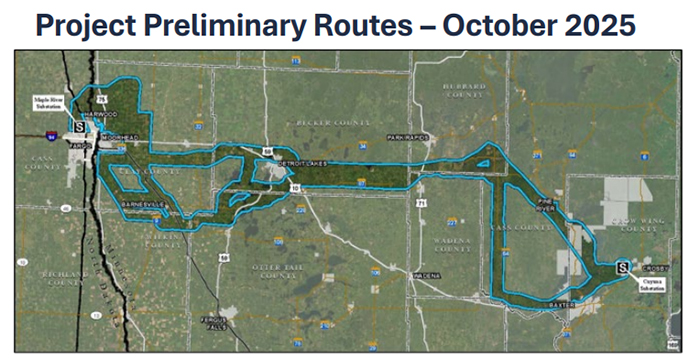
A more southern route from Fargo to Detroit Lakes includes the northwest corner of Otter Tail County affecting Dunvilla, the Pelican Lake area and running east to just northwest of Vergas.
The MR-C project was one of 24 approved projects, officially No. 20, in the Midcontinent Independent System Operator regional plan, according to Janke.
The project’s timeline was presented with 2026-28 centered on permitting, engineering, environmental surveying, right-of-way acquisitions and public engagement.
Construction is scheduled for 2029-32 and service is anticipated to be operational in 2033.
Narrowing down to a preferred route from the proposed routes will need to occur prior to most of the work planned for the next three years.
“Our policy is to co-locate a route alongside high-voltage transmission lines (100 kV+) as much as feasible,” said Janke.
Preliminary routes were presented. These will be evaluated and refined into a preferred route based on stakeholder feedback and engineering and construction considerations.
The routing process is a combination of routing criteria found in Minnesota and North Dakota statutes and regulations, engineering requirements, constructability needs, and cost considerations. To route a project, opportunities, constraints, engineering and construction considerations, along with public input are considered.
Janke stated hopes are to have a preferred route ready for public approval by the end of March.
“There are all sorts of opportunities for public comment and through the route permit process anyone can propose alternative routes for the commission to consider,” said Janke. “Just because we propose it doesn’t necessarily mean that’s what comes out on the back end.”
For more information on the project, visit: www.mrctransmissionproject.com/