
WCI’s Municipal Solar Cohort empowers rural cities to harness solar energy for public buildings
News | Published on January 13, 2026 at 1:20pm EST | Author: frazeevergas
0Frazee and Vergas have both been part of the solar project
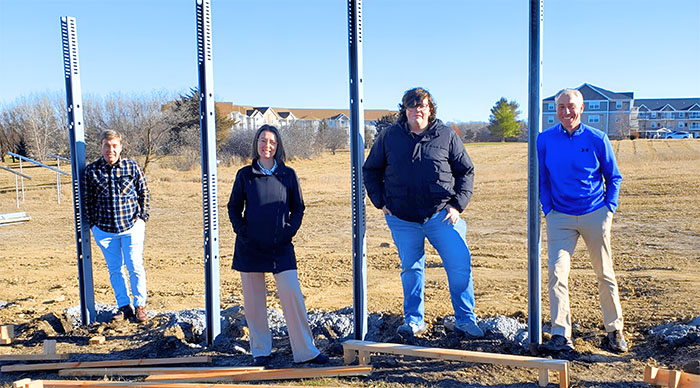
Photographed at West Central Initiative’s solar fence installation in progress, L-R: Ben Schierer, Cedar Walters, Griffin Peck, and Greg Wagner.
By Greta Hentges
West Central Initiative
Robert Williams
Editor
Communities across the region, including Frazee and Vergas, are taking bold steps toward a more sustainable and resilient future through the Municipal Solar Cohort. West Central Initiative (WCI) created the cohort to help communities develop project proposals for small-scale municipal solar projects. By working together, local leaders are finding practical ways to reduce energy costs, generate local revenue, and strengthen their communities through clean energy investment.
What began as an innovative idea to make solar power more accessible for small rural municipalities has grown into a collaborative effort that’s changing the way towns think about energy, community, and long-term planning.
To explore the cohort’s growing impact in the region, WCI connected with four team members—Cedar Walters, Ben Schierer, Griffin Peck and Greg Wagner—whose combined expertise in sustainability, partnerships, energy and economic development is driving this work forward.
Vergas
In Vergas, solar panels and batteries are being installed at the Event Center with multiple future uses, including as a city-wide backup power supply that could be used during an outage.
“Imagine if there was a city power outage, you could have a power base there, a resiliency center there for the community,” Vergas Mayor Julie Bruhn said in a 2024 interview with the Forum. “It’s been a learning curve, but it’s been really fun. We want to make sure we are doing this very data and research-oriented when we present it to the residents.”
Peck presented WCI staff analysis that showed an expected project cost of $104,280.23 and expected project incentives of $97,680.
The incentives create a near zero cost obligation to the city and the project will save Vergas $67,848 in energy costs over the project’s lifetime.
Bruhn also applied and was awarded grants from Empowering Small Minnesota Communities (ESMC) and Regional Development and Sustainability Partnership (RSDP) and created an action plan for research and audits of Vergas buildings. The building audits provided information on how Vergas can improve energy use, which will aid in energy cost savings, along with qualifying for tax incentives for improved efficiency. Vergas Clerk-Treasurer Julie Lammers submitted two years of energy use to examine consumption and aid the building audits.
“You can save up to $1,000-$2000 a month on your energy bills,” said Bruhn.
Frazee
Griffin Peck made multiple presentations of a solar analysis of the Frazee Public Works, Event Center and Liquor Store buildings.
Peck was joined by Holsen Solar owner Ben Holsen, a Fargo-based licensed contractor and electrician that performs residential, business and agricultural solar projects. Holsen solar was chosen by the group of cities for installations.
The Public Works building was selected to have a solar photovoltaic system installed on its roof.
The facility uses 71 kilowatts per year and the solar system will produce 67 kilowatts, thus cutting the electricity bill for the building by 94 percent, according to Holsen.
Total cost of the project is $106,439.14 that will be financed by rebates and tax incentives, including a $60,000 rebate from Otter Tail Power.
The additional tax credits equate to a total of $102,576, leaving a $3,800 balance for the city to pay.
“As Ben was saying, you’re going to save $5,800 a year so this project pays itself off from the energy savings in 12 months,” said Peck. “The city is expected to save $182,954 over the lifetime of the project, which is 30 years.”
Griffin Peck, Energy and Adaptation Planner
For communities thinking about adding solar to their municipal buildings, what do you most want them to know—especially about the technical side that often surprises or reassures them?
Representatives from WCI want communities in their region to know that solar isn’t scary. It’s one of the easiest ways to save taxpayer money by cutting operating costs and creating long-term savings.
In their first cohort, each community is using 1-3 years of energy savings and utility payments to cover the portion of the project not funded by incentives, rebates, or grants. After that, they save $2,000 to $6,000 every year for 25 years or more. That adds up to over $100,000 that can be reinvested in other local projects.
In Pelican Rapids, the solar array on the liquor store is already offsetting higher electricity costs from the new aquatic center. That’s the kind of impact solar can have for communities now and in the future.
How do you see your role in making the technical side of going solar easier and less intimidating for rural communities?
The solar landscape can be complex, even for those who work with energy systems every day. City clerks, administrators and elected officials already manage a wide range of responsibilities, so navigating the technical side of solar can feel like a lot to take on. Before college, Griffin Peck gained experience in energy analysis and modeling, and during my undergraduate studies, he focused on building energy use and utility rate analysis. Over the past three years, Peck worked on solar projects for cities across west central Minnesota and have seen how solar can be tailored to fit everything from 100-year-old buildings and wastewater treatment plants to liquor stores and small city offices.
Peck’s role is to make the process less intimidating by translating complicated topics like utility rates, solar production, and incentive programs into clear information about cash flow and return on investment. Sometimes my energy analysis uncovers savings beyond solar. In Hoffman, for example, WCI found a way to save the city $900 a year in demand charges at the fire hall just by changing equipment schedules.
Greg Wagner, Director of Business & Economic Development
How has our interest-free municipal solar lending, in partnership with the Municipal Solar Cohort, helped communities move their solar projects from proposal to reality?
Greg Wagner of WCI believes offering no-interest loans was a key motivator for cities in this first cohort to take the leap into solar. Elected officials are accountable to their constituents and must maintain fiscal responsibility for their cities. While lower utility bills and revenue from selling electricity back to the grid will generate savings over time, any improvement to municipal buildings comes with upfront costs that can strain budgets in communities of any size.
Although solar technology isn’t new, there’s still a perceived risk around its reliability and effectiveness. WCI helps address both concerns by reducing some of the initial costs. This approach not only eased the financial burden but also allowed participating communities to realize cost savings more quickly, which is exactly in line with our mission to help communities achieve success.
The Municipal Solar Cohort shows what’s possible when communities have the right support at the right time. By exploring solar energy, communities are not only saving money but also investing in a stronger, more sustainable future.