

Frazee Fire Department receives excellent PPC rating
News | Published on February 17, 2026 at 1:53pm EST | Author: frazeevergas
0Residents benefit from lowered property insurance rates
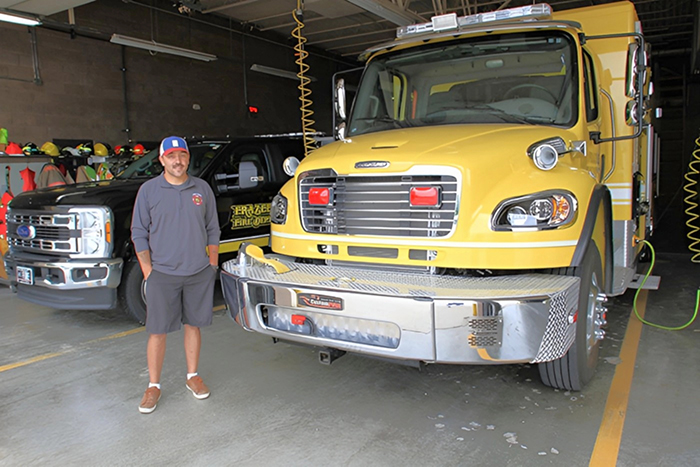
Fire Chief Adam Walker’s department passed evaluations of emergency communications, water supply and fire flows, along with equipment, staffing, training, operational considerations, community risk reduction and many other key factors with high marks that will also benefit residents by lowering their property insurance rates.
By Robert Williams
Editor
The Frazee Fire Department received a Public Protection Classification (PPC) rating of four during a summary report by Insurance Services Office, Inc. (ISO), in November of 2025.
“The ISO inspection went very well,” Fire Chief Adam Walker said. “We got a PPC rating of four, which is absolutely unheard of for a small town, rural community, such as ours. It should lower property insurance 10-15 percent for the residents of the city of Frazee and everybody within five to six miles. That’s a huge accomplishment for us at the fire department and the years we put in upgrading equipment, the training we’ve done and the services we provided to the city.”
ISO collects and evaluates information from communities in the United States on their structure fire suppression capabilities. The data is analyzed using the Fire Suppression Rating Schedule (FSRS) and then a Public Protection Classification (PPC®) grade is assigned to the community. The surveys are conducted whenever it appears that there is a possibility of a PPC change. As such, the PPC program provides important, up-to-date information about fire protection services throughout the country.
City Council Vice Chair Jim Rader examined the ISO report.
“I’m very impressed,” Rader said. “Shout out to all of you folks to make that rating as good as it is. That’s something that our community should feel really good about. That’s a rating as good as any small, volunteer fire department.”
The FSRS recognizes fire protection features only as they relate to suppression of first alarm structure fires. In many communities, fire suppression may be only a small part of the fire department’s overall responsibility. ISO recognizes the dynamic and comprehensive duties of a community’s fire service, and understands the complex decisions a community must make in planning and delivering emergency services. However, in developing a community’s PPC grade, only features related to reducing property losses from structural fires are evaluated. Multiple alarms, simultaneous incidents and life safety are not considered in this evaluation. The PPC program evaluates the fire protection for small to average size buildings. Specific properties with a needed fire flow in excess of 3,500 gallons per minute (gpm) are evaluated separately and assigned an individual PPC grade.
Frazee ranks in the top 35 percent of the nation, including full-time departments, according to Walker.
“It’s anywhere from 5-10 percent of volunteer, rural departments nationwide, so we’re in that top echelon nationwide as far as ISO rating goes,” said Walker.
“Kudos for that; that is something that our community should really applaud,” Rader said.
A community’s investment in fire mitigation is a proven and reliable predictor of future fire losses. Statistical data on insurance losses bears out the relationship between excellent fire protection—as measured by the PPC program—and low fire losses. So, insurance companies use PPC information for marketing, underwriting, and to help establish fair premiums for homeowners and commercial fire insurance. In general, the price of fire insurance in a community with a good PPC grade is substantially lower than in a community with a poor PPC grade, assuming all other factors are equal.
Mayor Mike Sharp echoed Rader’s sentiments.
“Just really appreciate your leadership, Adam, especially with this ISO rating; this is going to be big for our residents,” said Sharp.
ISO is an independent company that serves insurance companies, communities, fire departments, insurance regulators, and others by providing information about risk. ISO’s expert staff collects information about municipal fire suppression efforts in communities throughout the United States. In each of those communities, ISO analyzes the relevant data and assigns a PPC grade – a number from 1 to 10. Class 1 represents an exemplary fire suppression program, and Class 10 indicates that the area’s fire suppression program does not meet ISO’s minimum criteria.
ISO’s PPC program evaluates communities according to a uniform set of criteria, incorporating nationally recognized standards developed by the National Fire Protection Association and the American Water Works Association. A community’s PPC grade depends on:
• Needed Fire Flows, which are representative building locations used to determine the theoretical amount of water necessary for fire suppression purposes.
• Emergency Communications, including emergency reporting, telecommunicators, and dispatching systems.
• Fire Department, including equipment, staffing, training, geographic distribution of fire companies, operational considerations, and community risk reduction.
• Water Supply, including inspection and flow testing of hydrants, alternative water supply operations, and a careful evaluation of the amount of available water compared with the amount needed to suppress fires up to 3,500 gpm.