

OTC, planning commission support Vergas pursuit of daycare solution
News | Published on March 3, 2026 at 3:20pm EST | Author: Kendall Koenen
0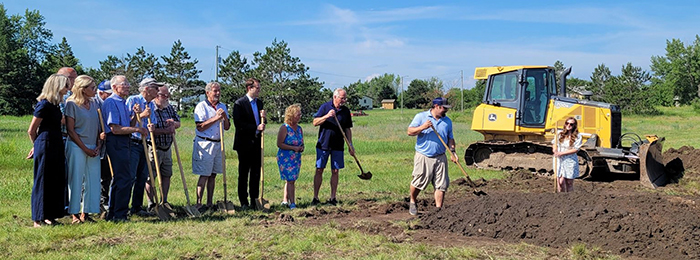
Sen. Jordan Rasmusson and other local and state partners celebrate the groundbreaking ceremony for the Ottertail Family Center last summer. The project is a larger model of what the Vergas EDA/HRA is pursuing for the open lot on Altona Avenue.
By Robert Williams
Editor
The working plan of the Vergas Economic Development Authority (EDA)/Housing Redevelopment Authority (HRA) to bring daycare to Vergas made the rounds of a special EDA/HRA meeting, the Vergas Planning Commission and the Otter Tail County Commissioners last week.
Formerly titled the “Vergas Area Housing Project,” a change to that moniker was made to “Growing up Vergas.” The change was made necessary due to contingencies and potential future use. If the title was too specific, as in using the word daycare, a future sale and change to senior or rental housing may not be possible. If the word housing is in the title it negates potential daycare funding, according to Clerk/Treasurer Julie Lammers.
“I, personally, like the title,” said Council Liaison Bruce Albright at the special meeting on Monday.
The EDA/HRA voted unanimously to switch the name to “Growing up Vergas.”
“One of the reasons why they chose the name ‘Growing Up Vergas’ is so that however we raise the funds they can change,” said Lammers.
Lammers went through multiple future scenarios where a daycare may not be needed as much as rental or senior housing and how the name will allow the property to switch between those scenarios.
“With ‘Growing Up Vergas’ we’re growing with any age group,” she said.
The Monday meeting was called to discuss a meeting between Estimator Matt Dreyer and Vice President Brad Neuerburg of Hammers Construction and Albright, Lammers and CEDA Representative Katie Gehring. Hammers designed the newly-opened daycare facilities in Ottertail.
“What came out of that is if they’re the general contractor then really all they need to do is take the Ottertail plans and make some changes; they can use their specifications, etc., and they’re comfortable with that,” said Albright. “They also told us that they are comfortable with using as many local suppliers as possible on the project.”
The EDA/HRA has eyed the Ottertail project as a blueprint for the proposed lot on Altona Avenue.
Not having those existing plans means the EDA/HRA would need the city engineers to draw up plans, design and specifications that could total as much as approximately $20,000.
For a cost of $2,000, Hammers was willing to examine the Ottertail designs and find cost-saving possibilities, like using different materials and other changes for a similar build in Vergas.
Another reason for the special meeting was the next EDA/HRA meeting is not until March 18 with a grant application due on March 15.
The Department of Employment and Economic Development (DEED) grant considers the Vergas project one location, according to Gehring, which limits the amount the EDA/HRA could be awarded to $100,000.
There is also a distinct lack of grant funds available. In the previous cycle, DEED awarded more than $6 million to 50 applicants. The funds for this cycle are only $1.4 million and only five to eight entities are expected to receive the award out of approximately 75 applicants.
If awarded the DEED grant, the project must be built within one year. Specifically, the construction side of the project would need to be completed by June 30, 2027, Gehring said.
Grant funds are expected to be awarded in late May to early June.
Another grant application requirement is a confirmation from Planning & Zoning that the potential daycare location is in a properly zoned location.
Planning & Zoning
The Vergas Planning & Zoning Committee met Wednesday, Feb. 23, which included a hearing about a conditional use permit (CUP) for the proposed daycare site at 303 Altona Avenue.
There are no definitive plans yet for the site; the EDA/HRA has signed a purchase agreement.
The main question was if a CUP was necessary for a daycare in town.
“I have looked at other communities and they do not have that,” Lammers said.
Instead, Lammers recommended changing the current ordinance to either removing “daycare” from needing a CUP or having the words “unlicensed daycare” needing a CUP.
The current conditional uses conditions under the R-1 Low Density Residential District ordinance are as follows:
(D) Conditional uses. Within the R-1 District no structure or land shall be used for the following except by conditional use permit and in conformance with the standards specified in division (I) of this section.
(1) Home occupations in a residence.
(2) Hospitals and nursing homes, licensed day care centers serving 12 or more people and
cemeteries.
(3) Accessory buildings other than those listed in (C)(1), including storage sheds and greenhouses over 12 feet in height or 500 square feet or covering more than 30 percent of the area of the side or rear yard in which they are located.
Lammers cited the many state laws and rules that already regulate daycare centers as a reason to not need a CUP.
“I think our job is to work with the locals to make sure they know what’s going on,” said Albright. “Any time we’ve had an issue it’s because people don’t know or have a misconception of what we’re doing.”
One issue that was clarified is that the daycare project is being done completely through grants and/or private donations and other fundraising and will not have any tax implications on Vergas residents.
Albright did mention current discussions on a potential sales tax in Vergas, but that money is already earmarked to fund the Long Lake park improvements. Should that tax pass the House and Senate, it would be on the next election ballot and if approved it would be in effect until the project is complete.
Regarding the city ordinance for daycares, Chairman Alex Ohman signed off on a letter stating the Altona Avenue address had been reviewed and confirmed it is zoned residential and a construction of a duplex is consistent with the intent and uses of the residential district and two childcare host sites serve an important community need and provides essential services.
The support for the project was voted unanimously in the affirmative.
Planning and Zoning committee member Dave Johnston proposed a second option for a future daycare and will discuss more with the city office in the coming weeks.
If another site was selected instead of the Altona Avenue lot, and Vergas was to receive the grant funds, an amendment could be made to the grant application to allow for funds to be used at the other location.
“While it sounds like are we putting all our eggs in 303?” said Albright. “No, the answer is we’re just checking a box basically and they require this letter from us to be a part of the application.”
County board
Otter Tail County reached out to Vergas to be a fiscal agent for the city for any grant monies received. The county must be the fiscal agent for Vergas, as a town with a population below 500 residents.
County Community Development Director Amy Baldwin discussed both the Vergas and a Fergus Falls project with commissioners on Tuesday, Feb. 24. Discussions included a formal request by the City of Vergas for a resolution from commissioners to provide a $5,000 or five percent grant match to strengthen an application to the DEED Child Care Economic Development Grant Program.
“They have looked at various options, existing structures, partnering and co-locating within a church facility that didn’t work out because of building code reasons and other partnerships,” said Baldwin.
The Vergas EDA/HRA is leading a collaborative project to address a critical shortage of licensed child care in the Vergas area. Through local partnerships with organizations including the City of Vergas, Lions Club and community members, the Vergas EDA/HRA plans to build a twin home that will be leased by licensed family care providers and create up to 24 new child care spots over the next three years.
“They are looking at the model of the City, or their EDA operationally, owning like New York Mills and Perham also own duplexes—where the cities own it and lease out to their providers,” said Baldwin. “These will be highly-competitive applications so the county’s support will be critical to make those applications competitive.”
Support from commissioners was unanimous and the growing need for more childcare options in the county was duly noted.
“Lord knows we need that childcare in Otter Tail County and any city that wants to start doing this kind of stuff – more power to them,” said District 1 Commissioner Dan Bucholz.
“We’re going to help them as best we can,” said District 2 Commissioner Wayne D. Johnson.