

Wakes celebrates doctorate milestone together
News | Published on May 13, 2026 at 10:21am EDT | Author: Kendall Koenen
0‘The process is in the perseverance’
By Robert Williams
Editor
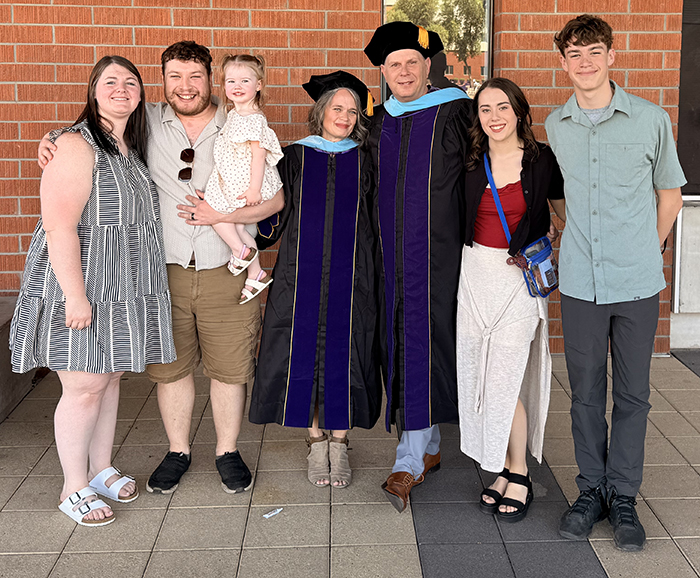
When this year’s group of graduating seniors were in seventh grade, Frazee-Vergas teachers Charles Wake, EdD, and Julie Wake, EdD, began a six-year pursuit of their doctorates in education. Both recently completed those efforts at the graduation for doctoral candidates ceremony at Grand Canyon University, in Phoenix, Ariz., Friday, May 1.
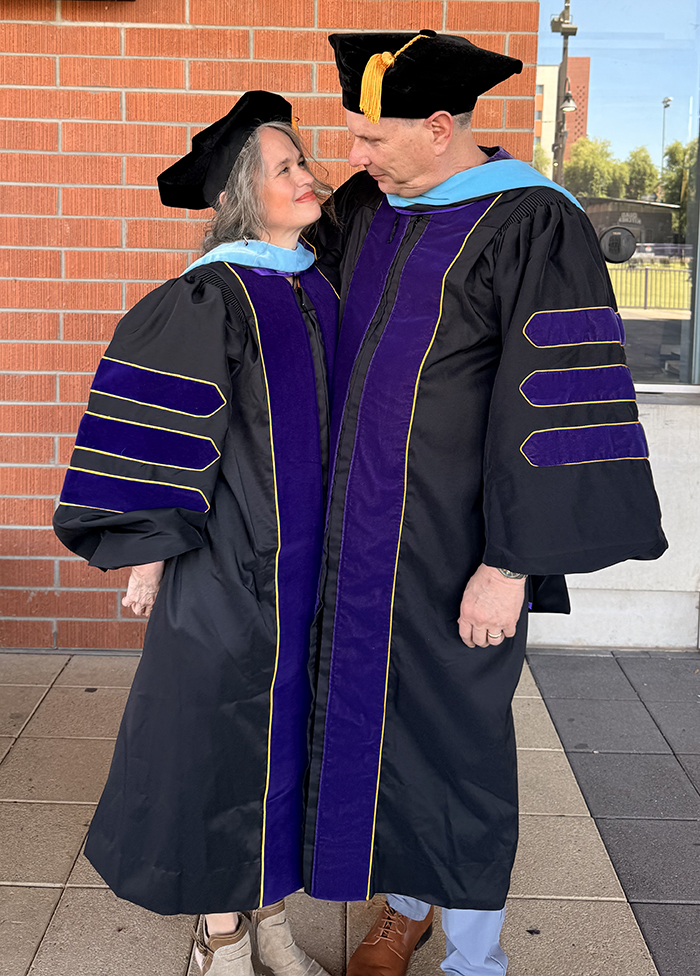
The Wakes began three years of classwork in December of 2019, followed by a rigorous process of years of writing, being challenged, and rewriting to be challenged again.
Both took wildly different paths and methods to that end and also to their teaching careers.
Julie knew her fate from a young age. Charles stumbled into his.
“I knew I was going to be a biology teacher in fourth grade,” Julie said. “I sincerely believe that everybody has a place in the world and I always tell my students as they’re trying to decide: If you look back at young you, what made your heart happy? What did you love to do? I just knew that’s what I like to do.”
By chance, Charles worked with kids at a young age and a girlfriend he had in college told him he was great with kids. While standing in the registrars line at college registering for classes, he was asked what he was registering for?
“Whaddya got?” he said.
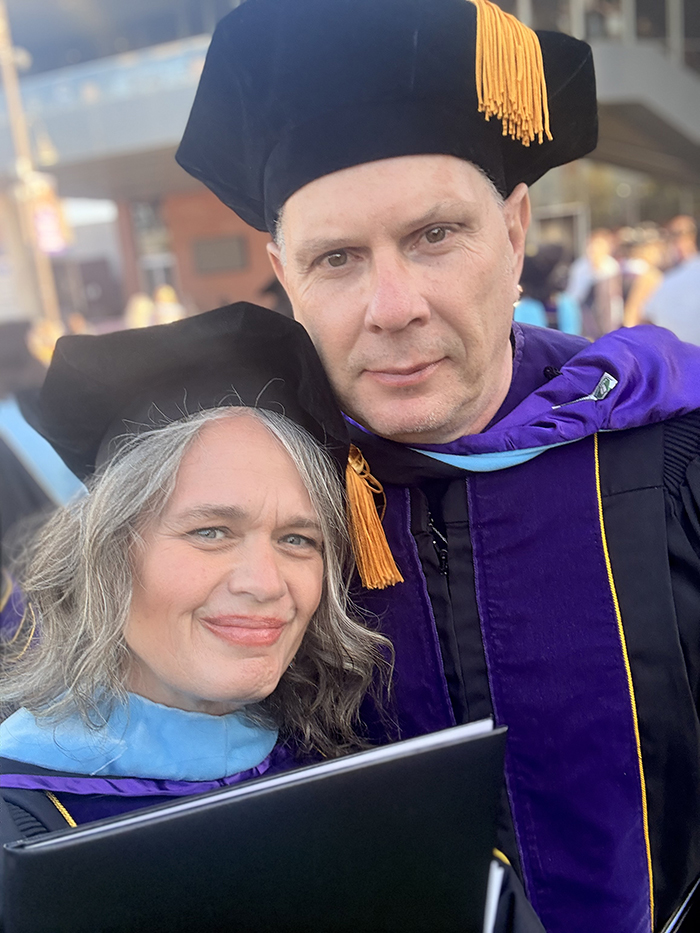
Julie and Charles Wake pose at the doctoral candidates graduation ceremony at Grand Canyon University, in Phoenix, Ariz.
Elementary education was available and he went with it. Charles is now licensed in elementary education, middle school science and social studies, a masters in education with an emphasis in physics, holds a physics license, an earth science license and now his doctorate.
Julie can be credited with assisting in those accomplishments.
“I drag him along in everything we do,” she laughed. “I told him I’m going to get my masters degree and so was he.”
That was the same way the couple got their doctorates, but how they got to them was again in completely opposing manners of pursuit.
“The doctorate was, I support you 100 percent,” said Charles. “Then she said, ‘We start Monday!’”
This interview conversation turned at the first-speaking of the word, “dissertation.”
Charles’ demeanor was calm and he sat quietly in his chair, while Julie squirmed in the family kitchen’s old church pew, spoke rapidly and efficiently in bursts, and showed many different emotions in her facial expressions.
The same elements made up their respective work styles.
“We’re Yin and Yang,” said Julie.
Charles secluded himself in his office starting early at 5 a.m., working until 10 p.m., with mental breaks throughout the day.
Every day.
“On Sunday, I’d get up and do the same thing,” he said.
Julie worked from a “nest,” – a chair in front of the television, legs crossed, papers everywhere.
“I’m planning a vacation and a dissertation,” she laughed.
Most of the 40 credits of classwork were completed remotely with three classes needed to be completed in-person in Phoenix.
“That is where you cram on your dissertation. All your classes before are just leadership, policy, laws, how to write, how to interview, things like that,” Charles said.
A doctoral dissertation is a substantial, original research document submitted as the final requirement for a PhD or professional doctorate.
“You had to stay a week and they had courses on writing your dissertation, what your dissertation is going to be on and the second class was—start writing,” said Charles.
“The classes were good; the dissertation process is a perseverance more than it is actually the process. The process is in the perseverance,” said Julie.
That dedication began with three-four years of writing and defending, then rewriting and defending, until final approval and publishing.
A friend of Charles once told him the process will make your mind go to dark places in your life.
“Definitely, there were times we thought…just walk away,” said Julie.
Both of the Wake’s dissertations concentrated on organizational leadership K-12.
Charles has published, “The Influence of COVID-19 on Teaching and Grading in Rural Midwestern Schools: A Qualitative Study.”
Julie is in the final stages of publishing, “Students’ Perception of Gender Bias through Teacher Expectations in Midwest High Schools.”
“You have to pick a topic that covers a gap in the literature,” Julie said.
Julie studied articles and studies dealing in gender bias and in each study would conclude with, ‘further research is warranted in…this.’
“So you compile that and see if anyone has done research in that,” said Julie. “You have to contribute something new in education. Mine ended up being how students perceive teachers’ gender bias in the classroom because all the research had focused on how teachers perceive their own. No one had asked the kids.”
Charles wanted to study grade inflation from 2019-20 and then COVID hit.
“There was going to be a huge gap on how teachers—did they inflate grades during COVID-19 just to get kids by?” he said.
Part of the process is having a chair to guide the writing and challenge it.
A dissertation chair is the faculty member who leads a doctoral student’s research committee, acting as the primary mentor, advisor, and evaluator throughout the dissertation process.
Both of the Wakes went through two different chairs before finding a more cohesive working environment with a third.
The second chair Charles had told him he could not pursue grade inflation because no teacher would admit to inflating grades unethically. He ended up changing it.
“It’s done in stages,” he said.
He wrote three chapters and then had to defend those three chapters followed by a trip to the Institutional Review Board (IRB) to get approval on who will be interviewed for the research.
“After you’ve passed the IRB, then you can start your study,” he said. “Then you can write chapter four and after passing chapter four then you can write chapter five. When we say passing, you write something and it is peer reviewed.”
Both of the Wake’s defined the peer review process as, “they just destroy it and we’re able to laugh at it now.”
“You are an idiot; learn how to write, it was pretty intense,” Charles said.
“It’s technical writing; there’s no feeling to it,” said Julie.
Listening to the full process is a grind. Completing it seems even worse.
“After all that’s done then you get to your major defense,” said Charles. “It’s six and half years of researching and jumping through hoops.”
“When we would send in a chapter, they would destroy it and you would spend every evening rewriting the chapter,” Julie said.
Charles admitted he had moments when he was ready to just quit the whole process.
“I’m still there,” he said.
Imagine writing 30 pages of references of other studies and quote attributions.
“He has said that the next crazy idea I come up with he is saying no to,” Julie laughed.
Post-defense, the dissertation needs to pass form and formatting where if it is kicked back another 12-week course needs to be completed.
Julie’s publication is currently just awaiting a signature from the Dean.
Looking back, working through multiple chairs was one of the biggest challenges.
For Charles, it was worthwhile, “even though it was intimidating, frustrating and demoralizing.”
“The dissertation goes with you everywhere,” said Julie. “You go on a weekend football game to Pennsylvania, the computer goes with you and you sit down and do work. We went on vacation, computers went with us and we did work.”
On a three-and-a-half week, European vacation, Charles used the train ride from France to Barcelona, Spain.
“That was a long train ride,” he said. “I sat there and I went through my chapter four. It went everywhere.”
Now at the completion of 6.5 years of struggle and success to complete their doctorate pursuits, the two, not surprisingly, have completely different perspectives and plans for the immediate future.
“I’m at peace,” said Charles. “I’m ready to go fishing. After this, I said, ‘I’m done.’”
“I have to do something else,” said Julie. “Do you want to go hike the trail in France together for two weeks?”
With the high school’s graduation ceremony coming this weekend, Julie recalled the paths of this year’s graduates and how they related to the dissertations.
“For years, we’ve heard them say, ‘You’re still working on that?’” she said. “It’s kind of cool that we finished and these kids started with us.
“I like teaching kids how to question and find their why? I don’t care if you remember a lick of biology when you leave if I’ve taught you how to think critically; how to understand different points of view, because biology has a lot. We can teach you what science can do. But ethics determines what it should do. Then I’ve made you capable to go out in the world.
“Like our doctorate, for me, I wanted these small town kids to see that small town doesn’t mean small dreams. Especially at Frazee where you get them from 7-12. They’re babies when they walk into seventh grade and then you watch them as seniors. We get to see the best of them. We know they’re going to make a difference.”
Graduation commencement at Frazee High School will be held Sunday, May 17, at 2 p.m., in the gymnasium. The Wake’s dissertations can be found on Google Scholar.