

County board backs election results, process
News | Published on August 28, 2026 at 3:27pm EDT | Author: Kendall Koenen
0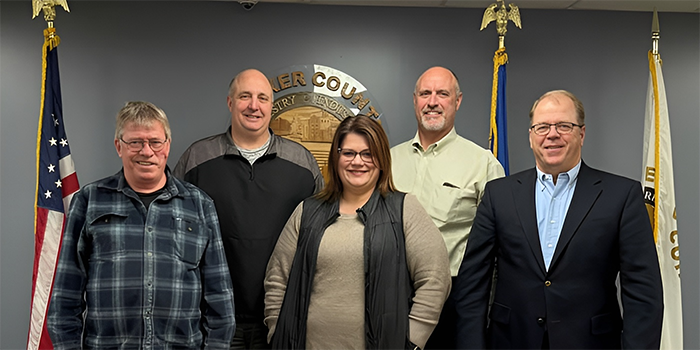
The Becker County Board of Commissioners, L-R: Richard Vareberg, David Meyer, Erica Jepson, Phil Hansen, and Barry Nelson held a number of lengthy discussions involving the primary and coming elections, department budgets, blighted properties, data requests, and easements in regards to crossing tax forfeited land during the latest board meeting Tuesday, Aug. 18, in Detroit Lakes.
By Robert Williams
Editor
Commissioner Barry Nelson addressed election security saying he believed elections in Becker County are secure.
“I truly believe, for Becker County and Minnesota, that our elections are secure from what goes into the machine and what’s counted there we can physically have every ballot there,” Nelson said.
Nelson also stated the importance of mail-in voting for rural precincts but also said he would like the process to be “tightened up” statewide and nationwide.
There are 16 townships that do mail-in balloting, according to Nelson.
“Those are small townships and I think the township supervisors would notify you if there was any suspicious activity,” he said.
The recent primary saw 26 percent of the county’s registered voters participate and Nelson credited that to the auditor/treasurer’s race.
Becker County has 23,600 registered voters out of roughly 35,000 eligible voters, according to Commissioner Phil Hansen.
A post election review will held at 9 a.m., on Thursday, Nov. 12. Part of the review process is to take all ballots from the city, a large and one small township and go over each ballot to make sure the hand count matches the machine results with officials from the city, county, auditor/treasurer and members of both parties present.
Human Services
Board Chair Erica Jepson discussed the Human Services budget and how state and federally-mandated programs cost counties.
There were significant increases to the budget, largely due to payroll.
“But, what I think is interesting is most of the services offered by Human Services are either state-mandated or federally-mandated,” said Jepson. “We don’t have anything that we say the county must do.”
Jepson then cited an analysis of funding sources provided by Human Services Director Denise Warren. Funding for how the county meets the Human Services budget comes from 30 percent federal sources, 22 percent state sources, 7 percent from what the county charges for services and the remaining 41 percent by levy request (the formal dollar amount a county government asks to raise through local property taxes to fund its annual budget).
“So, when we talk about unfunded mandates and how it costs counties,” Jepson said. “Human Services is here to do the work of what the county and federal government tells us what to do and we do it with 41 percent county money. I think that’s an important piece of information when we talk to legislators and remind them of unfunded mandates.”
Nelson and Jepson also discussed an increase in those costs when they are shifted or if funding is cut at the state level.
“It falls on us; the program needs to still be there,” said Nelson. “To cut those programs you actually have to cut the program and not just the funding.”
Jepson referred to the federal Supplemental Nutrition Assistance Program (SNAP) administration cuts. Federal legislation (the 2025 reconciliation law) is cutting nearly $187 billion from SNAP through 2034.
Estimated costs to the county were $200,000-$300,000 but were actually $155,565.
“Still significant, but not as much as we thought it would be,” said Jepson.
“Just that one item that we have no control over will increase property taxes one-half percent,” Nelson said. “And there are numerous of those types of items.”
Hansen said he discussed the topic with Otter Tail County and there are 42 Social Services line item mandates that have to be done.
Discussion turned on why state or federally-mandated programs do not automatically come with state or federal funding, along with outdated programs that distort contemporary funding.
Jepson cited foster care as an example. There are federal programs that help support placement if they meet certain income criteria.
“That income criteria hasn’t been updated since the ‘80s, so how many kids meet that criteria, which then means Becker County is left to pay for that placement to make sure that child is safe,” Jepson said.
“It’s a no-win situation for us,” said Nelson.
County Administrator Carrie Smith noted discussions that have been had about creative ways, including AI systems, to manage unfunded mandates to take pressure off the financial programs.
“I think Human Services is doing a really good job looking at how can they get creative to really manage the financial cuts that are coming,” said Smith.
Blighted properties
More than one residence near Brandy Lake in Detroit Lakes involving two property owners have been recommended for potential civil, criminal charges, or both, due to blighted properties.
One property that was under an internal committee review had shown recent improvements, while two other properties were stated as “having regressed,” according to County Administrator Smith.
A common area that is being used for communal storage is also in question.
A Spruce Grove property currently has a case against it and was reported to have shown no to very little progress. The property owner has until Oct. 1 to show significant improvement before facing potentially more charges.
An Acorn Lake property is just into the process and will be notified of the committee’s concerns regarding a number of vehicles on the property and ordinance violation.
A Rock Lake property will also be referred for charges due to a lack of progress.
An Otter Tail River contract for deed property has been defaulted on and committee hopes are the original owner will help resolve the issue.
Data requests
During her report, Smith reported a review is needed of the data request process due to an increase of those requests.
“We’re seeing more and more data requests for a lot of information,” said Smith.
Preliminary discussions, including with department heads, have centered around current systems or finding a newer system to be used for tracking purposes of the requests, along with a need for an overall review of the request form, charges and processes.
“It hasn’t been reviewed since I’ve been here, but I think it’s probably a good time to take a look at (it),” said Smith.
Proper tracking would avoid duplicate work and allow for a central database of the requests. Some of the larger departments of the county complete and store their own completed data requests and do not automatically share that information with those requests that are handled by other departments or Smith and her office.
AI is also compounding the issue with specific requests for information that can take a significant amount of time to locate and organize.
Easements
A property owner request by Matt Smith, a Frazee graduate, created a conversation on easements in relation to tax forfeited lands and potential charges and fees for said easements not being charged by Becker County.
The Becker County Board seldomly approves road easements over unsold Becker County Tax Forfeited Lands to an individual or private entity requesting access to their private property. All easement requests must first be brought to the township for approval or denial. If the township approves, they are obligated to sponsor the road easement. If denied by the township the applicant must come to the county board for approval or denial.
A county board may convey a road easement across unsold tax-forfeited land to an individual or a private entity requesting an easement for access to private property owned by the individual or private entity if:
(1) there are no reasonable alternatives to obtain access to the individual’s or private
entity’s property; and
(2) exercising the easement will not cause significant adverse environmental or natural resource management impacts.
(b) The county auditor shall require an individual or a private entity applying for an easement under paragraph (a) to pay the appraised value of the easement. The conveyance must provide that the easement reverts to the state in trust for the taxing district in the event of nonuse.
Natural Resources Management Supervisor Mitch Lundeen clarified that the county has never charged the appraised value of an easement in his four years on the job. He noted there were three-four applications in that same timeframe.
For example, Aitkin County charges $2,000 per acre; Clearwater, Hubbard and St. Louis counties charge $1,000 or $1,500 per acre. Other counties use an assessor’s land schedule. Application fees run from $0 to $2,000.
Commissioner Hansen questioned whether a policy could be created that would encompass all situations but was answered by Lundeen that these issues typically need to be done on a case-by-case basis, which is why the review process is so rigid.
It was agreed upon that by statute the county should be charging for the easements with questions around charging one person for a public easement, the question of whether or not to allow access, or future needs or development of the property versus potential restrictions to the one parcel or not.
“It’s tough to put a value on going across public land, but we selling them a right to something, because a lot of the time what comes in behind this is a utility easement,” Lundeen said.
The board charged Lundeen to return to the board with a potential fee schedule of charges, along with the county’s options.
In memoriam
Smith acknowledged the passing of Jim Gottenborg, who passed away on Aug. 11. Gottenborg worked at Becker County Courthouse for 20 years.