

Catholic Mass ceases at Menahga, Verndale; closures to follow in 2027
News | Published on September 2, 2026 at 5:38pm EDT | Author: Kendall Koenen
0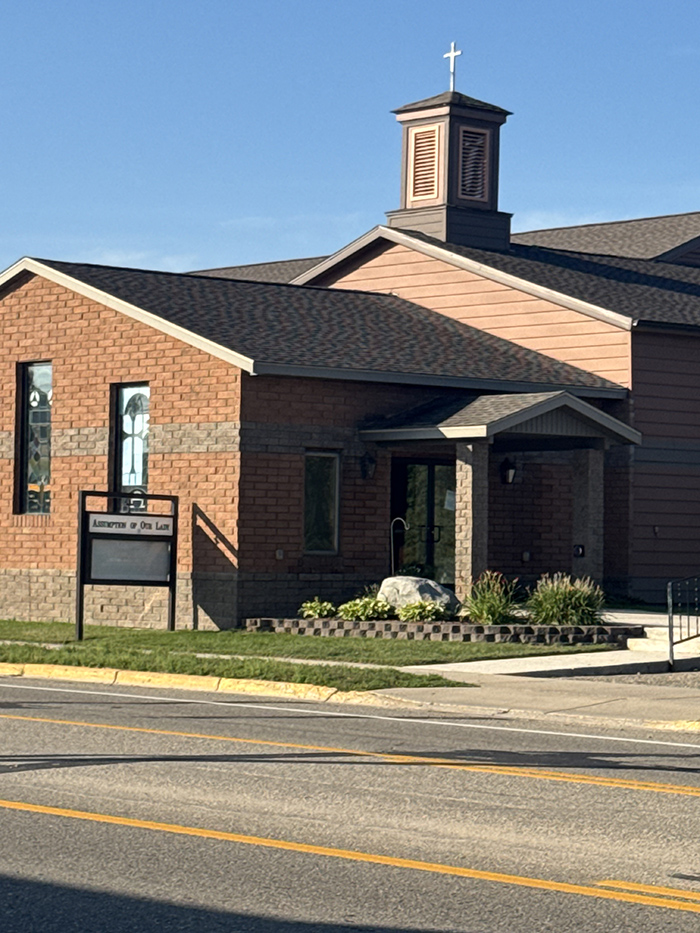
By Matthew Johnson
Reporter
he Mary, Mother of the Church Area Catholic Community (ACC) is in the process of a “realignment” of its eight area parishes, essentially “unifying” them into one large parish in four existing locations, according to the Rev. J.C. Duncan of the Diocese of St. Cloud.
Duncan said the ACC parishes at Menahga, Bluffton, Verndale and Bertha will eventually be closed and united with the other four ACC parishes to become one parish in four existing locations. Those four existing parish locations that will remain open are at Wadena, Blue Grass, Staples, including the Sacred Heart Area School transitioning this school year to a hybrid, home school preschool ministry; and Motley. Part of that process, he said, includes ceasing Mass at those first four sites followed later by the closure of those sites. The entire process is being overseen by Bishop Patrick Neary of the Diocese of St. Cloud.
Duncan says Neary is referencing Jesus’ “Behold, I make all things new” pronouncement in Revelation 21:5 to set the tone for the realignment and unification process.
“The bishop is looking at our footprint,” said Duncan.
The actual physical footprint of what will make up the one, unified parish, following the realignment and unification, will ultimately be smaller with Menahga closed on the north end and Bertha closed on the south end.
Currently, the eight parishes are spread out over a large area that includes the parishes along Highway 10 from Bluffton to Motley and the parishes along Highway 71 from Bertha to Menahga.
The process has begun, as Mass ceased in Menahga following the weekend of Aug. 15-16, and in Verndale following the weekend of Aug. 1-2. Mass is expected to cease at the Bluffton parish in January of 2027 and at the Bertha parish in the summer of 2028, said Duncan.
He said the parishes where Mass has ceased will continue operating as individual parishes including the usual fundraising/events for the time being, with all other parish activities functioning as usual. The remaining parish sites will also retain their individual parish names.
“From the outside, most people won’t notice the naming changes at the sites that remain open,” Duncan said.
The parish closures won’t occur, he said, until Neary holds a final Mass in each of the four designated locations, after which the closures will follow. Duncan said the closures of the Our Lady of the Assumption Catholic Church parish in Menahga and the St. Frederick Catholic Church parish in Verndale will not take place until sometime in 2027 with dates yet to be determined.
Also, Duncan said the parish cemeteries will continue being maintained as usual even after the closures. God is asking parishioners not to look at their own comfort but rather embrace the mission of making disciples within the universal Catholic church around them, he said.
“We belong to the Universal (Catholic) Church – one body,” Duncan said. “We’re here to serve the church Universal. It (the realignment/unification process) is quite remarkable, reminding us of that fact.”
As for the future of the actual buildings in the four locations being closed, he said plans for those will wait until an appropriate “grieving” period has passed. Then, next step discussions concerning the buildings will be held within the diocese and, ultimately, the bishop will sign off before any of the buildings would be sold or given to a particular entity. The bishop will not sign off on the sale/transfer of property to an entity if he believes selling/transferring it to said entity would compromise the high utilization standards of the diocese, Duncan said.
“It can’t fall to ‘unbecoming use,’” he said.
Duncan said a number of developments have contributed to the decision to embark on the realignment and unification of the ACC parishes. These include fewer priests over the past few years, the advanced age of the parishes, a decline in the number of children, the challenge of providing appropriate accessibility accommodations for individuals with disabilities and a decline in the average number of parishioners in the pews during Mass.
Duncan did clarify that there has been an encouraging number of young men, both married and single, joining the parishes as of late with these developments expected to continue through and beyond the current process.
The question arose: “As a rural diocese, how can we match the trends?”
Duncan said the trends have been occurring over a number of years, and consensus within the diocese is that the current changes are appropriate at this time.
“It’s what makes sense in light of us being a mobile society,” he said.
Our Lady of the
Assumption
Catholic Church
The ACC has provided historical information about Our Lady of the Assumption Catholic Church in Menahga.
The mission was established in 1953 and in 2003 the Rev. Albert Holmes made the following assessment of what had become the local parish for a St. Cloud Visitor article as parishioners planned to celebrate the 50th anniversary: “They are a very tightly knit group of parishioners. What they lack in numbers they have in fervor and spirit. There’s an intimacy with them. When they celebrate Mass, you know they’re celebrating Mass.”
It was the third smallest parish in the diocese at that time with 180 members. Parishioners did what needed to be done including partnering with the community and pairing with a number of other churches.
The mission was incorporated on Aug 28, 1953, following requests from Catholic families. Monsignor Edward Mahowald, St. Ann’s pastor, was assigned by Bishop Peter W. Bartholome to serve Menahga.
Eager local families wasted no time as Hugo Pulju and Edward J. Murphy negotiated for the acquisition of the C.H. Zimmerman house and three lots were purchased for $5,500, as well as two additional lots for $825. All told a quarter of a block next to Highway 71 had been acquired for the local mission and land for a cemetery was donated by Mr. and Mrs. Donald Spangler.
Volunteers made a temporary altar and set up folding chairs in what was the living room, dining room and kitchen of the Zimmerman place for Masses that began on Aug. 31. Other rooms served as office space and sleeping quarters for the priest.
The first Mass was attended by 38 people. Attendance grew rapidly with the Rev. Joseph Linn, assistant pastor at Wadena, serving the mission.
Soon parishioners located another building to expand the mission with a $1,000 bequest from an anonymous donor and $5,000 from the Catholic Church Extension Society.
The Ristanen General Store building was purchased and Pulju’s construction and house moving business moved the 36X64-foot building about a block and a half to the church property in April 1954. The shed-style roof was replaced with a new roof and Traynor & Hermanson architects from St. Cloud donated their services to design the entrance and belfry, which created a colonial style appearance.
Parishioners also donated their labor to turn the general store into a church. The work was nearly complete when Bishop Bartholome named and dedicated the local parish with 280 participants on Aug. 17, 1954. That number included 55 priests/deacons.
Sixteen parishioners were confirmed after Mass and a meal was served in the basement. The rectory was created from the Zimmerman house. It was later rented and eventually demolished.
The mission officially transitioned into a parish in 1958 with the Rev. Cletus Herman, O.S.C., as its first resident pastor.